


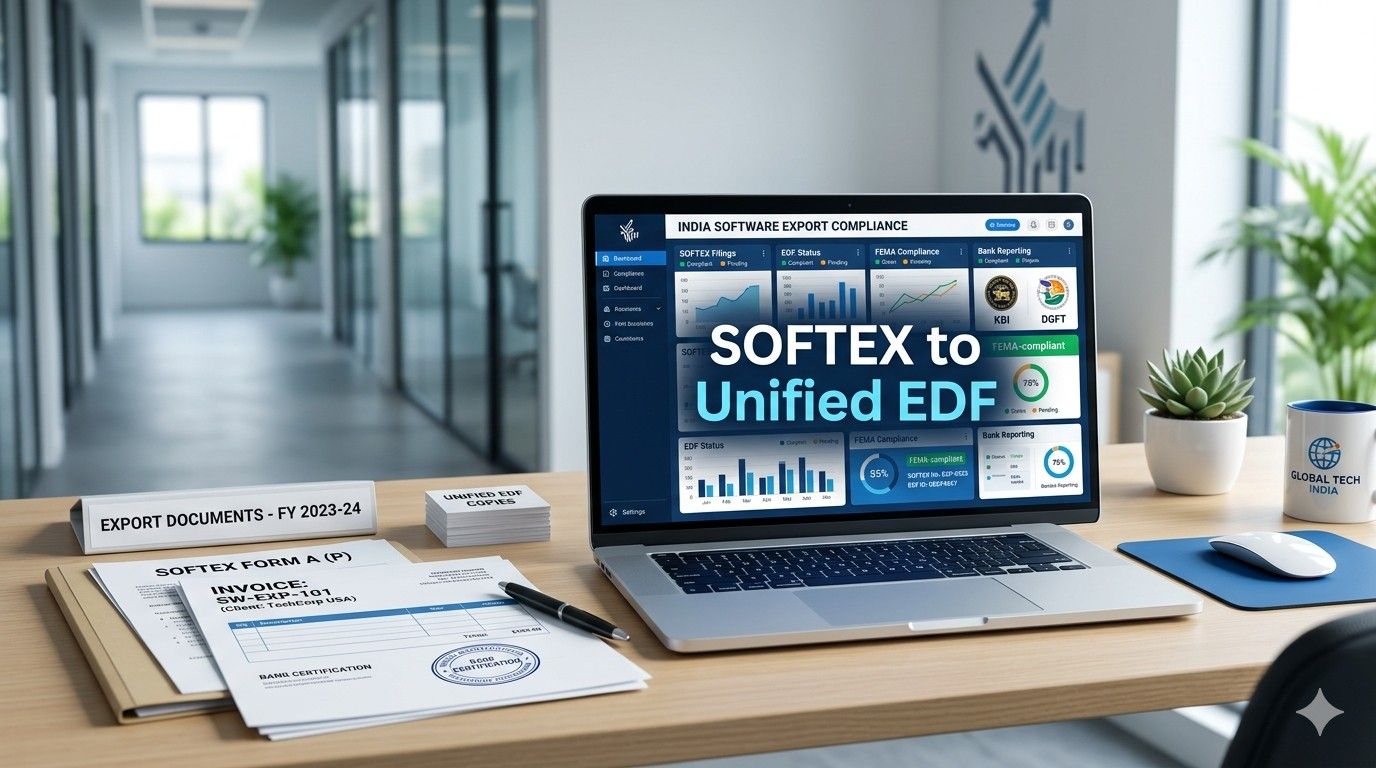

From October 2026, Indian software and service exporters will move from the traditional RBI SOFTEX form regime to a unified Export Declaration Form (Unified EDF) framework under new FEMA regulations, fundamentally changing how exports are reported and monitored. Understanding this transition early will help IT companies, startups, SaaS firms, consultants, and freelancers avoid FEMA/RBI compliance headaches and payment delays.
For years, Indian software and IT-enabled service exporters have used the RBI SOFTEX form to declare export invoices to the Reserve Bank of India through STPI or SEZ authorities, mainly to track foreign exchange under FEMA. This created a parallel compliance layer in addition to GST, banking, and customs documentation, often leading to duplication and confusion.
Under the Foreign Exchange Management (Export and Import of Goods and Services) Regulations, 2026, RBI has decided to phase out the stand‑alone SOFTEX mechanism and replace it with a single Unified Export Declaration Form (EDF) for goods, services, and software exports, effective 1 October 2026. This shift is designed to improve ease of doing business, reduce paperwork, and bring all exporters under one FEMA/RBI reporting framework.
The SOFTEX form (often called the “RBI SOFTEX form”) is a regulatory declaration used by Indian businesses exporting software or IT/ITeS services to report their export invoices and foreign exchange earnings to RBI. In simple terms, it functions like a “shipping bill” for intangible exports such as software, SaaS subscriptions, implementation services, and remote consulting.
Historically, SOFTEX forms were filed through Software Technology Parks of India (STPI) or SEZ Online systems, and then certified by these authorities before being routed to the exporter’s Authorized Dealer (AD) bank. The primary purpose under FEMA/RBI was to ensure that export proceeds were realized within the prescribed time (earlier around 9 months, now typically extended under new rules) and properly recorded in RBI’s systems.
The RBI SOFTEX form was mandatory for:
Generally, all units registered under STPI or SEZ and exporting software/services were expected to file SOFTEX for eligible invoices, typically within 30 days of invoice date. Non‑filing could affect FEMA compliance and sometimes delay GST refunds for zero‑rated exports.
Read Blog :- Decoding FEMA Regulations
Even though SOFTEX is being phased out, many exporters still need to file it for invoices raised before the cut‑off date, so the process remains relevant during the transition period. The standard online approach is:
The Unified Export Declaration Form (Unified EDF) is RBI’s new single export declaration mechanism for goods, services, and software under FEMA 2026. Instead of separate processes (shipping bills for goods, SOFTEX for software, and almost no structured mechanism for many services), all exporters will now report through EDF in a consolidated framework.
Key objectives behind Unified EDF include:
RBI and the Government have repeatedly emphasized ease of doing business, reduction of paperwork, and stronger but simpler foreign exchange monitoring. The earlier SOFTEX regime created overlaps with GST, customs, and banking records, adding compliance without necessarily improving data quality.
By bringing all exports under one EDF, RBI aims to:
The table below gives a quick, content‑writer‑friendly snapshot you can reuse in SEO content:
| Aspect | SOFTEX Form | Unified EDF |
|---|---|---|
| Governing framework | Separate software export mechanism under earlier FEMA rules. | Single FEMA 2026 export–import regulation covering goods and services. |
| Scope | Software and IT/ITeS exports only. | All goods, services, and software exports. |
| Filing channel | STPI/SEZ portals; certification by STPI/SEZ authorities. | Integrated customs–bank digital ecosystem; AD banks as primary certifiers. |
| Reporting style | Invoice‑wise forms, multiple SOFTEX numbers. | Unified EDF, often with consolidated/monthly reporting options. |
| Compliance burden | Parallel to GST and bank docs, higher paperwork. | Reduced duplication, single declaration framework. |
The shift from SOFTEX to Unified EDF touches a wide spectrum of exporters:
Non‑IT service exporters, who often existed in a grey area earlier, will now be explicitly required to file EDF, making FEMA/RBI compliance much more uniform across sectors.
RBI’s new export–import FEMA regulations were notified in January 2026, with an effective date of 1 October 2026. Between notification and October, a transition window allows exporters, AD banks, STPI/SEZ systems, and fintech platforms to adapt their processes and technology.
Key milestones you should track in your content:
For a smooth migration from SOFTEX to Unified EDF, exporters should:
While RBI’s detailed formats are routed through banking and customs systems, most exporters can expect to need:
These are broadly similar to what exporters already maintain for SOFTEX, but now integrated into a single EDF‑based compliance trail.
Businesses are likely to face three broad sets of issues during the move from SOFTEX to Unified EDF:
Proactive planning can convert these pain points into an opportunity to clean up export documentation and standardize FEMA/RBI processes.
To keep your blog actionable for readers, highlight these best practices:
Non‑compliance under FEMA can have serious consequences:
Timely migration from SOFTEX to Unified EDF is therefore not only a procedural change but a core FEMA/RBI compliance requirement.
Specialized FEMA and RBI advisory firms (you might brand yours as “Fema Expert”) can play a crucial role in this transition:
Positioning such a service in your blog makes it easy for readers to see the value of expert hand‑holding during this regulatory shift.
Do not confuse the compliance term “SOFTEX form” with Softex Industrial Products Private Limited / Softex Industrial Products Pvt Ltd, which is an ISO‑certified manufacturer‑exporter of industrial rubber and plastic products based in Kolkata. The company name happens to contain “Softex”, but it is unrelated to RBI SOFTEX filings or Unified EDF requirements.
The transition from RBI’s SOFTEX form regime to a Unified EDF framework under FEMA 2026 is one of the most important regulatory changes for Indian software and service exporters in recent years. Exporters who understand what SOFTEX was, why Unified EDF is being introduced, and how to realign their processes with FEMA/RBI expectations will enjoy smoother bank dealings, fewer queries, and faster realization of export proceeds.
SOFTEX is a software export declaration form prescribed by RBI for Indian businesses exporting software and IT/ITeS services, mainly to monitor foreign exchange under FEMA. It is typically filed through STPI or SEZ systems and certified before being shared with the AD bank.
The SOFTEX form captures details like contract number, invoice value, client information, and currency so that RBI can track export earnings and ensure timely realization of proceeds. It also acts as a key supporting document for GST refunds on zero‑rated software and service exports.
Any Indian entity exporting software or IT/ITeS services and receiving foreign currency—STPI/SEZ units, software companies, SaaS startups, IT service providers, and eligible freelancers—is generally required to file SOFTEX. The form is usually filed within a defined time (often 30 days) from the invoice date.
To file SOFTEX online, you must generate a SOFTEX number from RBI’s portal, log in to the STPI or SEZ online system, fill the SOFTEX form (often via CSV upload), attach invoices and contracts, and submit for certification. Once approved, you receive certified SOFTEX details which you share with your AD bank for FEMA/RBI compliance.
You visit RBI’s EDF/SOFTEX portal and generate single or bulk SOFTEX numbers, which then get linked to your export declarations in the STPI/SEZ system. These RBI‑issued numbers are mandatory for tracking software export invoices in the central foreign exchange monitoring system.
Yes, from 1 October 2026 the SOFTEX regime is being phased out and replaced by a unified Export Declaration Form (EDF) that covers goods, services, and software exports. After that date, new software/service export invoices will be governed by the EDF framework rather than separate SOFTEX forms.
Unified EDF becomes mandatory under RBI’s FEMA 2026 export–import regulations from 1 October 2026, replacing the existing 2015 framework. Until then, exporters will follow legacy processes (including SOFTEX) while preparing for the transition.
All exporters of goods, services, and software—whether large IT companies, SaaS startups, consultants, agencies, or freelancers—must comply with EDF filing requirements through their AD banks. This brings non‑IT service exporters, who previously had limited formal export declarations, firmly under FEMA/RBI monitoring.
Yes, SOFTEX filings will continue for eligible software exports during the transition period up to the effective date of the Unified EDF regulations. However, no fresh SOFTEX filings are expected once EDF becomes fully effective, and exporters should clear any pending certifications before the cut‑off.
A FEMA/RBI expert (your “Fema Expert” service) can assess current SOFTEX and export documentation, design an EDF‑ready SOP, coordinate with AD banks, and train finance teams on the new regime. This reduces transition risk, avoids FEMA violations, and ensures export proceeds flow smoothly under the updated RBI framework.