
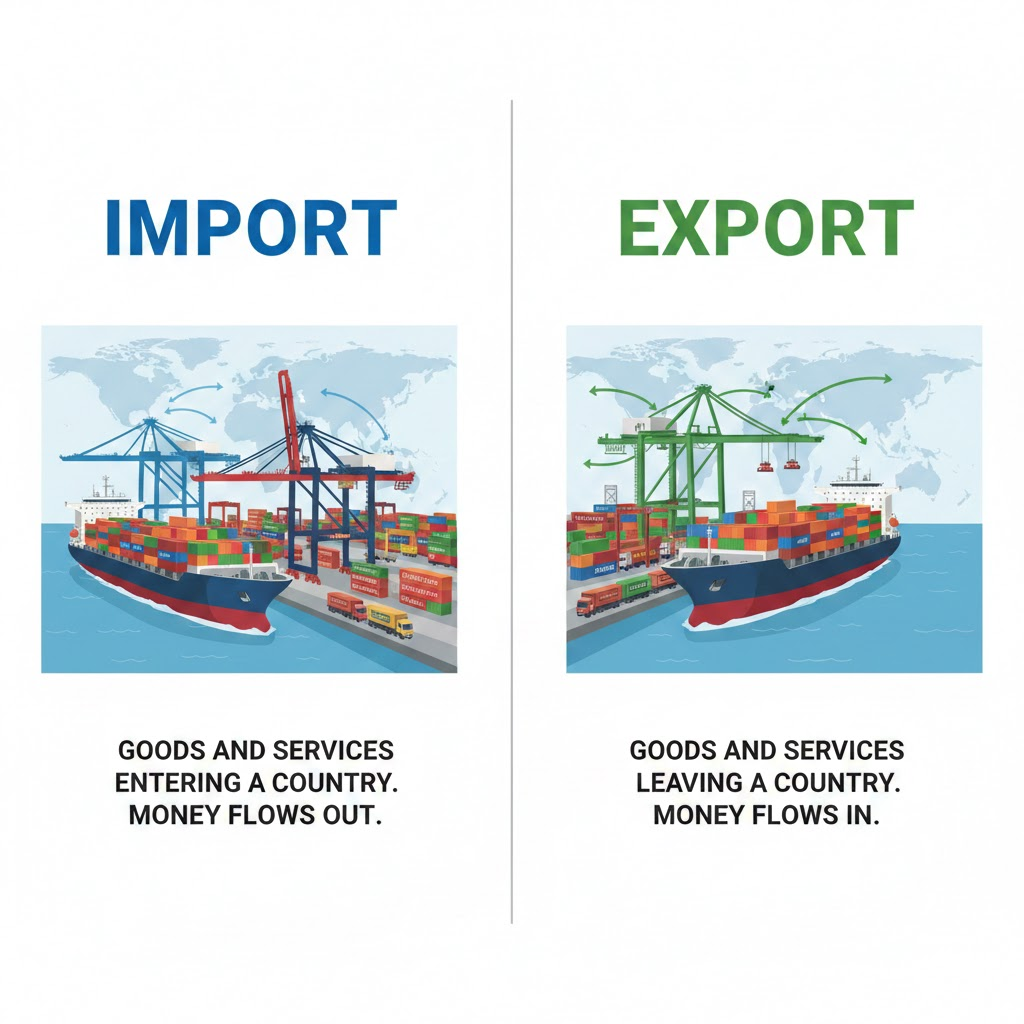

Import and export involve selling products or services across international borders. Imports are goods or services brought into a country from abroad, while exports are those sent out of the country to foreign markets. International trade drives economic growth successful export businesses, for example, tap into larger markets and leverage national competitive advantages. Conversely, importing lets businesses access cheaper or unavailable inputs (e.g. machinery, components). Together, imports and exports form a country’s balance of trade, an indicator of economic health.
In simple terms, importing means purchasing goods/services from a foreign country, causing an outflow of domestic funds. Exporting means selling domestically-made products to buyers abroad, bringing money into the country. For example, if an Indian textile firm ships garments to Europe, those garments are exports for India and imports for the buying country. Conversely, when a factory in India buys machinery from Germany, that machinery is an import. Keeping exports higher than imports (a trade surplus) typically signals economic strength.
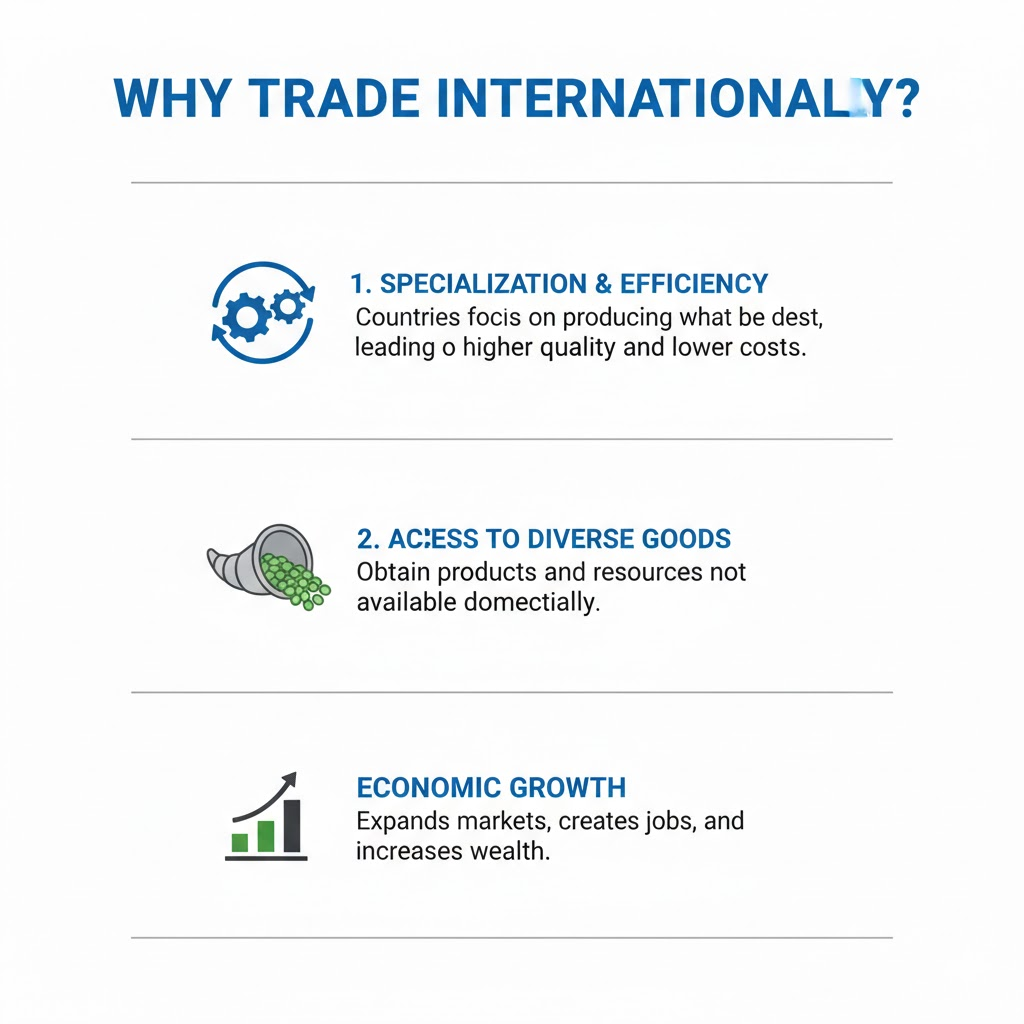
Expanding beyond local markets can greatly benefit businesses. Exporting lets companies increase sales and profits by reaching more customers. It also allows firms to exploit cost or quality advantages – for example, Indian IT or pharmaceutical firms export overseas because they offer quality at lower cost. Importing can lower production costs or improve product quality by sourcing materials or equipment that are not available domestically. In practice, businesses that engage in both import and export often see faster growth, better risk diversification, and enhanced competitiveness on a global scale.
1. Formal Registration: First, establish a legal business entity (sole proprietorship, partnership, LLP, or company) in your country. Choose an appropriate structure and name. In India, for example, you must obtain a PAN (Permanent Account Number) from the tax authorities and register for GST (Goods and Services Tax), since exports are typically zero-rated for GST.
2. Bank Account for Foreign Exchange: Open a current account with an Authorized Dealer (AD) bank that handles foreign exchange. This dedicated account will be used for all import (payments to foreign suppliers) and export (receiving payments from foreign buyers) transactions. Ensure the branch is not marked NFEI (no foreign exchange inward) – you need a branch authorized for cross-border transactions.
3. Obtain Import-Export Code (IEC): In most countries (e.g. India), an Import Export Code is mandatory to conduct any international trade. The IEC is a 10-digit license issued by the government’s trade authority (DGFT in India). You must apply online with your PAN and other documents; no exports/imports can be made without it. (For example, India’s Foreign Trade Policy explicitly states “no export can be made without obtaining an IEC”.) The application usually requires a cancelled cheque or bank certificate plus address proof of the business.
4. Other Registrations (Optional): While not mandatory for every product, many exporters obtain an Registration-Cum-Membership Certificate (RCMC) from the relevant Export Promotion Council (such as APEDA for agri-products or FIEO for mixed items). An RCMC can unlock export incentives or schemes. Also register on customs e-filing portals (like ICEGATE in India) once you have IEC and GST, so you can file shipping bills or bills of entry electronically.
5. Choose Products and Markets: Carefully select what you will import or export. For exports, pick products where you have a competitive edge (e.g. quality, cost, unique design). India’s top exports include electronics (smartphones, machinery), engineering goods, pharmaceuticals, organic chemicals, textiles (rice, spices, tea, garments), and jewelry. For imports, identify inputs that are cheaper or better sourced abroad (e.g. crude oil, electronics, machinery). Perform market research: study demand in target countries, tariffs, standards, and cultural preferences. Use resources like Export Promotion Council reports, trade portals, or commercial intelligence (trade data websites, export promotion bodies) to guide your choices.
6. Develop Documentation: Preparing correct documentation is crucial. Key documents for export include:
Similarly, import documents include:
Always keep complete sets of documentation, as customs authorities scrutinize these files to permit cross-border movement.
The import process mirrors this: you identify foreign suppliers, obtain IEC, place purchase orders, arrange shipping to your country, clear customs by filing a Bill of Entry, pay any duties, and receive the goods. In India, importers also file form ANF 2A for IEC and must register with ICEGATE.
Throughout both export and import, meticulous coordination between seller, buyer, freight forwarder, bank, and customs agents is essential.
International shipping involves complex logistics. Goods may travel by sea (container ships for cost-effectiveness) or air (fast but expensive). Inland transport (trucks, rail) connects factories/warehouses to ports. To handle this, most businesses engage Freight Forwarders: specialists who book cargo space, arrange inland haulage, and prepare transport documents. They work closely with Customs Brokers (CHAs) who file customs paperwork and handle inspections at ports or airports.
Understanding Incoterms is critical when contracting shipments. Incoterms are standard trade terms (published by the ICC) that define who pays for transport, insurance, and who bears risk at each stage. For example:
Choosing the right Incoterm in your sales contract clarifies who handles what and prevents misunderstandings.
Shipping Logistics. Efficient movement of goods is vital. Freight forwarders coordinate shipments (for example, arranging multiple cargo containers to the same country to reduce cost). In India, once the shipping documents are ready, exporters register accounts (AD codes) at their bank to receive foreign currency. For instance, exporters register a Foreign Remittance Account and a Refund/Incentive Account so payments from overseas banks can be remitted correctly. This back-end banking registration is a key part of the logistics chain in India’s export-import cycle.
Whether exporting or importing, goods must clear customs. In India, this process is largely electronic via ICEGATE. An exporter files a Shipping Bill on ICEGATE, specifying HS codes, value, duty-drawback claims, etc. Upon approval, customs stamps Let Export (Green Channel) or Hold (for examination). Similarly, an importer submits a Bill of Entry and pays any import duty to release cargo. Engaging a licensed Customs House Agent (CHA) can simplify this, as they know local procedures and tariffs. Always classify products under the correct Harmonized System (HS) code to avoid delays or fines. Remember, accuracy in invoices, packing lists, and shipping bills is crucial errors lead to hold-ups.
After customs clearance, cargo is loaded onto the carrier. Keep copies of all documents, as you’ll need them for the buyer’s bank or for importing country compliance.
Handling international payments requires care. Common methods include:
Also consider export financing and insurance: banks often provide pre-shipment (working capital) and post-shipment loans. In India, Export Credit Guarantee Corporation (ECGC) offers insurance cover against buyer non-payment. Such instruments can protect against commercial risk (bankruptcy of buyer) and political risk (war, currency blockades).
Setting the right export price is complex. You must cover all costs – cost of goods, packaging, inland freight, international freight, insurance, customs duties (at origin or destination), commissions – plus your profit margin. Be sure to quote in the buyer’s currency or a neutral one (like USD/EUR) and factor in expected currency fluctuations. One practical tip: hedging through forward contracts or pricing in a hard currency can shield you from volatile exchange rates. For example, if you quote in USD but your costs are in INR, a sudden rupee devaluation will boost your INR revenue; conversely, if INR strengthens, you risk loss. OWIT notes that many exporters simply price in dollars to transfer currency risk to buyers.
In summary, calculate your landed cost (all expenses) plus margin. Check competitor prices in the target market to stay competitive. You may also explore duties and taxes: some buyers expect CIF pricing (including duties), others prefer FOB (ex-works) pricing plus their own logistics.
International trade carries risks beyond ordinary business risks. Key risks include:
By recognizing these risks, you can adopt safeguards (insurance, legal advice, contract clauses, diversification) to run your import-export operations smoothly.
Online Marketplaces & Trade Fairs: Use global B2B platforms like Alibaba, Global Sources, IndiaMART, and trade directories to list your products. International trade shows and exhibitions (physical or virtual) are excellent for face-to-face networking. Chambers of Commerce and government trade bodies often organize buyer-seller meets. Building a professional website and using social media/LinkedIn also increases visibility.
Leverage Agencies: Contact export promotion councils (e.g. APEDA, FIEO in India) and embassy trade wings, which can connect you to importers. Local export assistance centers (often part of commerce departments) provide market intelligence.
Digital Marketing: Ensure your website ranks in relevant searches. As one exporter noted on Reddit, “try B2B platforms like Alibaba or trade shows, and focus on strong SEO so buyers can find you”. You can also use email campaigns and targeted online ads in countries of interest.
Databases and Trade Data: Tools like ImportYeti or government trade portals can show who is importing goods similar to yours. Knowing your buyer’s customers or preferences is half the battle.
India’s export portfolio is diverse and constantly evolving. Some top categories (with FY2024-25 values) include:
Focus on items where you can add unique value (quality, design, price). Also consider niche handicrafts or services (IT, textiles, software) which may have growth potential.
Once operational, grow your export-import business by:
Finally, scale gradually. Strengthen one export market before moving to another, and always ensure production, quality, and finance can support expansion.
Compliance with trade laws and foreign exchange regulations is a must. In India, the Foreign Trade Policy and Customs Act govern imports/exports. Equally, the Foreign Exchange Management Act (FEMA) dictates how cross-border payments are made and reported. For example, any foreign remittance or receipt often requires Form 15CA/CB filing with the Income Tax Department under FEMA rules.
Specialized consultants (e.g. “FEMA Experts”) offer end-to-end advisory. As one firm notes, they provide “comprehensive service for all transactions that fall under FEMA” and address every foreign exchange query. In practice, consult with a trade lawyer or compliance specialist to handle GST, customs duties, RBI approvals (if doing large foreign borrowings or investments), and ensure all filings (like Annual Foreign Liabilities and Assets returns) are timely. Good compliance avoids legal hassles and penalties.
Since we mentioned Incoterms, here are a few common ones:
Always agree on an Incoterm in your contract to know who pays for shipping, insurance, and duties, and where risk shifts from you to the buyer.
Q: What is the difference between export and import?
A: Export means selling goods or services produced domestically to a buyer abroad; Import means buying foreign goods/services into your country. For example, exporting computers to the USA brings money in, while importing oil pays money out. Exports add to GDP and foreign exchange, whereas imports meet domestic needs. (More detail on these terms can be found in basic trade guides.)
Q: How do I start an export-import business?
A: Key steps include: registering your business (e.g. company or partnership), obtaining tax IDs (like PAN and GST in India), opening a bank account for foreign exchange, and applying for an Import-Export Code (IEC). The IEC is mandatory for any cross-border trade. Next, decide what products to trade, ensure you meet legal/licensing requirements, and set up logistics (freight forwarders, warehouses). The Indian Trade Portal lists step-by-step guidelines (organizing your entity, IEC, RCMC, ICEGATE registration, etc.).
Q: What documents are required for exporting goods?
A: Core export documents include: Commercial Invoice (with Packing List), Bill of Lading (sea) or Airway Bill, Shipping Bill (customs export declaration), Certificate of Origin, and insurance papers. If you have a Letter of Credit, you’ll also need a Bill of Exchange. Each country may have additional requirements (certifications, permits). Always double-check both your country’s export checklist and the import requirements of your buyer’s country.
Q: How do I obtain an IEC (Import-Export Code)?
A: In India, for example, you apply for IEC online at the DGFT portal. The process requires your PAN, a canceled cheque of your business bank account, and address proof. The IEC is linked to your PAN and costs a nominal fee (₹500 in India). No exports or imports can be carried out without this code.
Q: Which payment methods are safest for international trade?
A: Letters of Credit (LCs) are often safest for exporters, as the bank pays you once shipping documents meet the LC terms. Cash-in-advance (100% prepayment) eliminates payment risk but may scare off buyers. D/P (Documents vs Payment) or D/A (Documents vs Acceptance) offers moderate security. New exporters rarely use open account (full credit), as it’s highest risk. Choose the method balancing your risk appetite and buyer relationship.
Q: How do I price a product for export?
A: Include all costs (production, packaging, inland freight, shipping, insurance, duties, commissions, etc.) plus desired profit. Quote in a stable currency (USD/EUR) or the buyer’s currency. Factor in exchange rate movements – some exporters even price in USD and let the buyer bear currency changes. Research competitor prices abroad and adjust for quality or service differences.
Q: What are Incoterms and which one should I use?
A: Incoterms are standardized trade terms defining who pays for shipping, insurance, and when risk transfers. For example, FOB (Free on Board) means you load goods on a ship at your port (buyer then pays freight); CIF (Cost, Insurance, Freight) means you pay to ship and insure to the destination port. There’s no one-size-fits-all Incoterm; choose based on how much responsibility you and the buyer can manage. Beginners often start with FOB (if exporting) to clearly delineate responsibility at the port of shipment.
Q: How can I find reliable overseas buyers?
A: Use B2B marketplaces (Alibaba, TradeIndia), attend international trade fairs, and network through export promotion councils. A verified website and LinkedIn presence help buyers find you. One small-business owner advises focusing “on platforms where international buyers are already searching”. That means listing on B2B directories, optimizing your website SEO, and reaching out via chambers of commerce or industry associations. Local export agencies or your government’s trade outreach programs may also give buyer leads.
Q: What are common risks in import-export and how to avoid them?
A: Major risks include shipment damage/loss (mitigate with cargo insurance), non-payment by buyer (use LCs or insurance), currency swings (hedge or price in hard currency), and compliance issues (keep all licenses and customs docs accurate). Thorough due diligence on partners, contracts with clear payment terms, and obtaining insurance/credit cover (e.g. export credit insurance) are standard risk management strategies.
Q: How can digital marketing help my export business?
A: Digital channels are powerful: maintain a professional, multilingual website and optimize it for SEO so buyers abroad can find you. Use targeted online advertising and social media (LinkedIn is key for B2B). Content marketing (case studies, catalogs online) showcases your credibility. Email campaigns to trade leads and presence on industry forums also generate inquiries. As noted above, even small exporters emphasize the role of SEO and online directories in reaching global customers.
Q: What support is available for export-import?
A: Governments often provide support via Export Promotion Councils, subsidies (like duty drawback), and helplines. In India, for example, DGFT issues trade policies and schemes; banks offer export financing; and experts (such as FEMA consultants) can advise on foreign exchange compliance. Joining a local chapter of international trade organizations (e.g. women or small business trade groups) can also provide training and networking opportunities.
These answers, coupled with careful planning, clear documentation, and smart networking, will help you run your import-export business smoothly and efficiently. Good luck with your international trade journey!