


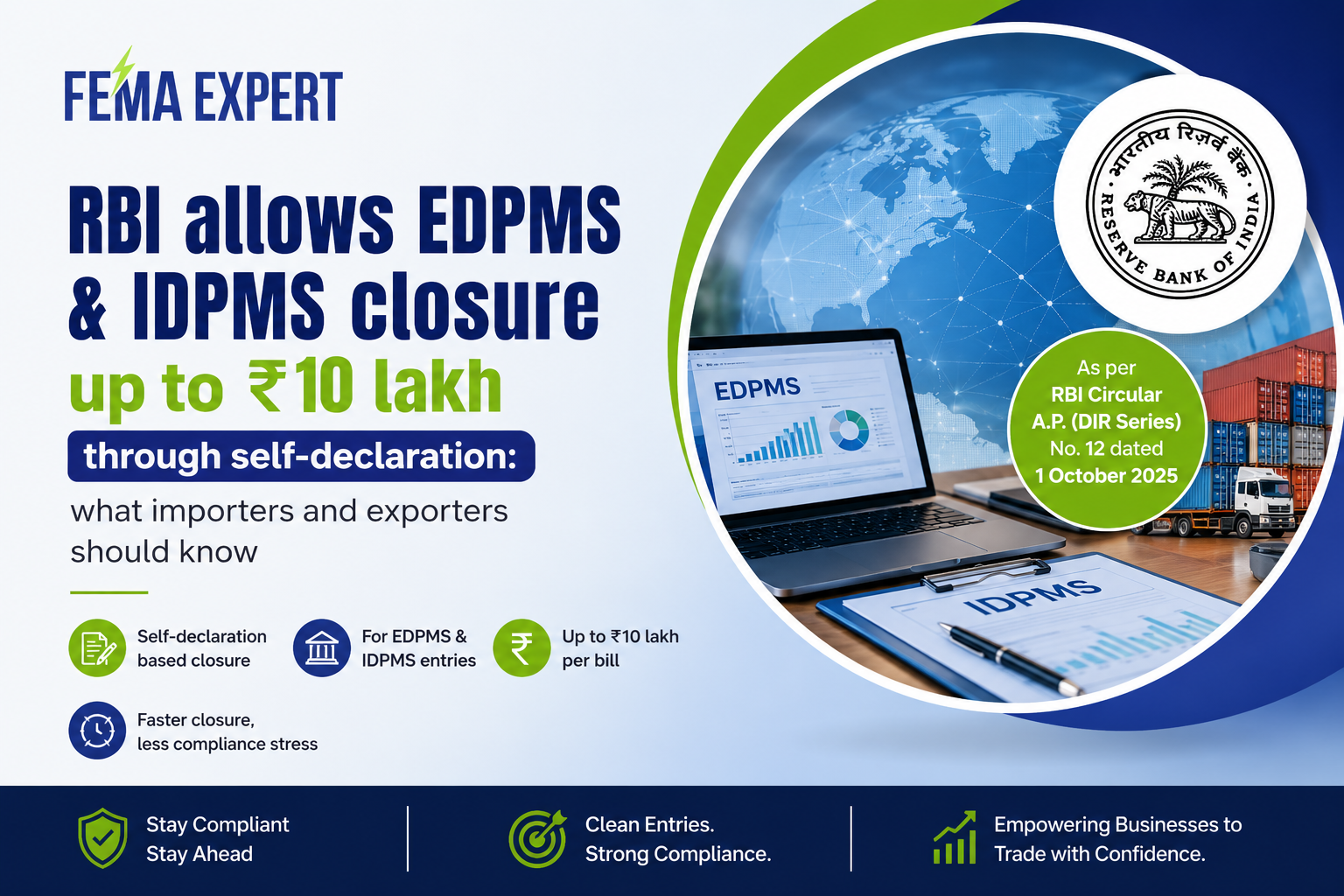

RBI has now allowed Authorised Dealer (AD) banks to close EDPMS and IDPMS entries up to ₹10 lakh per bill purely on the basis of a self-declaration from the exporter or importer, under A.P. (DIR Series) Circular No. 12 dated 1 October 2025. This has big implications for cleaning up old outstanding entries and reducing compliance stress for small and mid-size businesses.
If you handle exports or imports, you already know this story.
Your EDPMS or IDPMS report from the bank shows a long tail of “open” shipping bills and bills of entry. Payment is actually received or made long back, but entries are still outstanding in the system. One fine day, you get an email from the bank’s trade desk saying:
“Please close these old EDPMS/IDPMS entries immediately.”
“Else the account may be caution-listed / transactions may be held up.”
This creates unnecessary tension for CFOs, treasury heads and finance teams who are already juggling cash flows, audits and board reviews.
The good news: RBI has now formalised a simple, declaration-based route to close small-value entries in both EDPMS and IDPMS, up to ₹10 lakh per bill. Used properly, this can take a lot of pressure off your compliance calendar.
If you want consultancy go to Fema Expert Advice.
Before we talk about the new relaxation, let’s clear basics. Many teams still ask, “EDPMS full form kya hai, and why is it such a big deal?”
Export Data Processing and Monitoring System
It is an RBI-driven online platform used by Indian banks to report export transactions, from shipping bill or SOFTEX filing to receipt of foreign currency and eventual closure.
In simple terms, EDPMS does three things:
It connects your shipping bills or SOFTEX filings with foreign currency receipts in your bank account.
It monitors whether export proceeds are realised within RBI-permitted timelines.
Once entries are matched and closed, banks can issue eBRC for exports.
When entries remain open in EDPMS despite payment already being received, it signals a mismatch between your books, bank records and RBI systems. That is why AD banks regularly follow up for closure proofs and reconciliations.
On the import side, RBI runs a similar system.
Import Data Processing and Monitoring System
It is a central online platform used to track import transactions into India and match them with corresponding foreign exchange payments.
IDPMS connects customs, banks and RBI so that:
In practice, most businesses do not access any separate RBI login called an “IDPMS portal”.
Instead, companies usually access IDPMS information:
So when businesses refer to the “IDPMS portal”, they usually mean the combined ecosystem of RBI systems plus their AD bank’s reporting interface.
From a CFO or controller’s perspective:
Both systems are monitored through customs data, bank reporting and RBI supervision under FEMA.
If your books, bank records and RBI systems do not reconcile properly, businesses can face:
That is why regular reconciliation is becoming a core treasury and compliance function for exporters and importers.
On 1 October 2025, RBI issued A.P. (DIR Series) Circular No. 12 titled:
“Export Data Processing and Monitoring System (EDPMS) & Import Data Processing and Monitoring System (IDPMS) – reconciliation of export/import entries – Review of Guidelines.”
The key change is extremely important.
For entries up to ₹10 lakh per bill in EDPMS and IDPMS, AD Category-I banks can now close entries solely based on a declaration from the exporter or importer.
The exporter must declare that export proceeds have been realised.
The importer must declare that payment has been made.
This relaxation also applies to:
RBI has clearly stated that the objective is to reduce compliance burden and facilitate faster closure of entries for small businesses.
Banks have also been advised to review charges and avoid penal costs for delays under this relaxed framework.
When businesses create internal SOPs around this circular, a few points are important:
Businesses can also report:
However, this is not a blanket write-off mechanism.
Disputed imports, unrealised exports or large unresolved gaps may still require:
Ask your AD bank for:
Then filter entries below ₹10 lakh.
For every entry:
This reconciliation exercise is critical before issuing declarations.
RBI allows quarterly consolidated declarations combining multiple small bills together.
Your annexure can include:
This makes bulk clean-up much easier for high-volume businesses.
Use:
Ensure consistency between:
Share the signed declaration with the trade desk and request:
If this exercise is done every quarter, businesses can significantly reduce old outstanding entries and lower caution-listing risk.
Because IDPMS is not a public self-service RBI portal, bank coordination becomes extremely important.
Many AD banks now provide:
Finance teams should monitor these regularly instead of waiting for year-end issues.
Most mismatches happen because:
Strong internal document discipline reduces manual intervention significantly.
Large importers and exporters should conduct periodic trade desk reviews covering:
This prevents last-minute panic before audits, FEMA reviews or inspections.
Most finance teams know EDPMS and IDPMS exist, but very few truly understand how entries are created, matched and finally closed.
That is where a focused hands-on workshop becomes valuable.
The goal is practical implementation — not just theoretical understanding.
Teams should leave the workshop knowing exactly how to clean up real EDPMS and IDPMS backlogs inside their organisation.
EDPMS stands for Export Data Processing and Monitoring System.
It is RBI’s export monitoring platform where banks report export transactions and track whether export proceeds are realised within FEMA timelines.
It also supports eBRC generation and export compliance monitoring.
IDPMS stands for Import Data Processing and Monitoring System.
It tracks import transactions from Bill of Entry stage to final foreign exchange payment.
Businesses generally access IDPMS data through their AD bank’s trade portal or bank-generated reports rather than a separate RBI login.
Under RBI A.P. (DIR Series) Circular No. 12 dated 1 October 2025, entries up to ₹10 lakh per bill can be closed through self-declaration confirming:
This includes old outstanding entries and small value reductions.
Yes.
RBI has explicitly allowed quarterly consolidated declarations covering multiple small bills together.
This is particularly useful for:
The simplified declaration-based route applies only up to ₹10 lakh per bill.
For larger entries, AD banks may still require: