




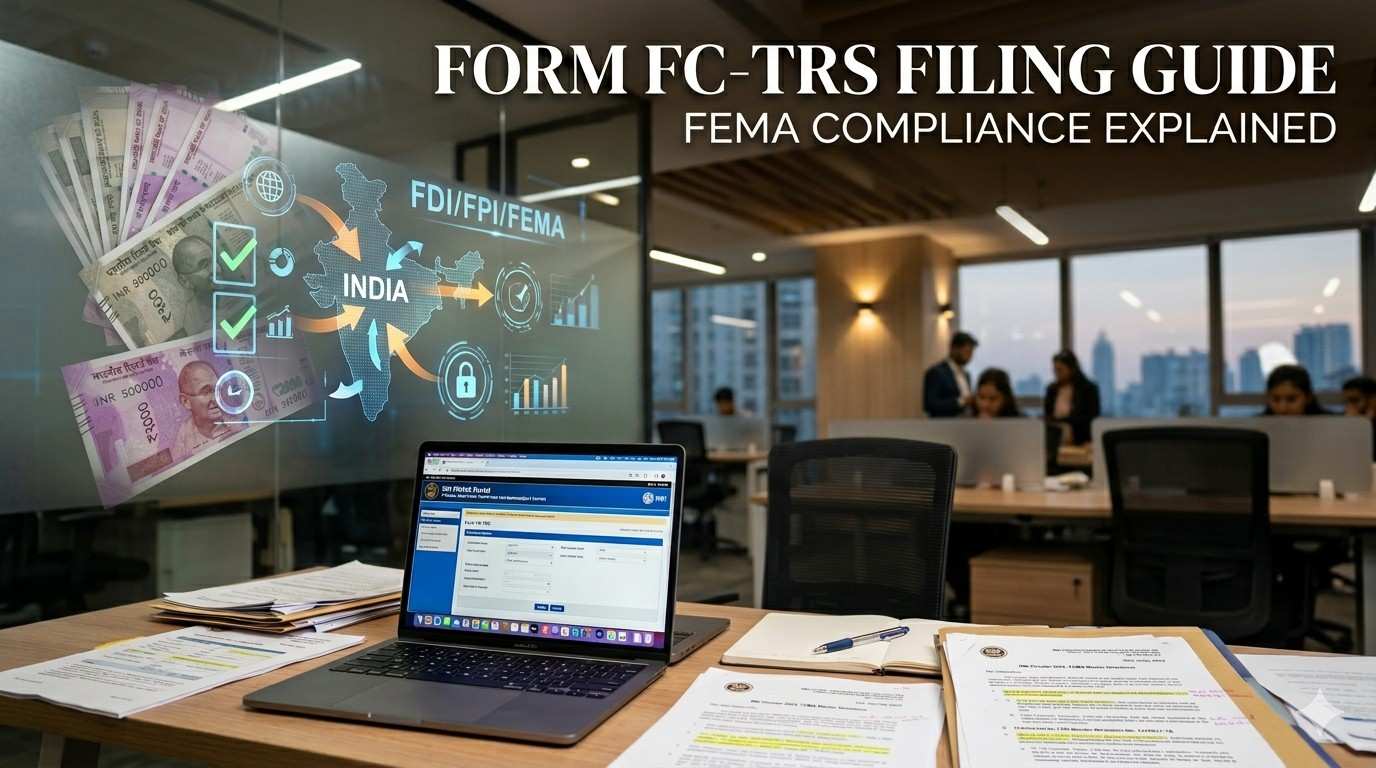
As India continues to attract global investors and drive outbound investments, understanding FEMA compliance has never been more important. Every cross-border transaction whether it’s a new investment, share transfer, or acquisition involves certain reporting responsibilities with the Reserve Bank of India (RBI).
Hi, I’m CA Happy Agarwal, and over the years, I’ve helped numerous startups, corporates, and investors navigate the complexities of FEMA filings, particularly Form FC-TRS. Many clients often ask the same question “When exactly is FC-TRS filing required?”
So, I decided to create this comprehensive guide that explains not just the scenarios where it applies, but also how you can ensure perfect compliance with RBI regulations and avoid penalties.
To start with the basics Form FC-TRS stands for Foreign Currency Transfer of Shares. It is a FEMA reporting form that covers share transfers between residents and non-residents.
It’s filed online via the FIRMS portal of the Reserve Bank of India and is a mandatory compliance step when ownership of shares changes hands across borders.
Legal context: This filing is governed under the Foreign Exchange Management (Transfer or Issue of Security by a Person Resident Outside India) Regulations, 2017.
Who files the form?
Timeline: Within 60 days from either the transfer date or the receipt of consideration whichever happens first.
Purpose: It ensures the RBI maintains a clear record of inflows and outflows of foreign capital in Indian companies.
From experience, I can tell you proper and timely FC-TRS filing builds your investor’s confidence and keeps your future FDI or ODI transactions smooth.
Now, let’s get into the heart of the topic the real-world scenarios where Form FC-TRS becomes necessary.
Every case requires proper valuation, documentation, and FEMA analysis before reporting.
In my practice, I’ve seen many founders assume FC-TRS is required only for FDI inflows but share transfers during M&A, ESOPs, or even gifts can trigger filings. Always get it reviewed before executing the transfer.
There are also situations where filing FC-TRS is not necessary, and confusing it with similar forms is a common mistake.
Reporting share transfers under FEMA is essential to maintain transparency and regulatory compliance in foreign investment transactions. The framework ensures that all cross-border dealings involving shares are properly documented and monitored by the relevant authorities. Depending on the nature of the transaction such as transfer between residents and non-residents, or vice versa specific reporting forms must be filed within prescribed timelines. Each form is designed to capture detailed information about the transaction, helping regulators track foreign investment flows accurately and ensure adherence to applicable rules.
Key compliance points I insist clients remember:
Your FC-TRS obligations connect directly with the RBI’s Master Directions on Foreign Investment in India. These detailed guidelines explain:
These directions are not just formalities they are the regulatory foundation on which FEMA reporting stands.
Whenever I advise corporates on foreign share transfers, I refer directly to the Master Directions to avoid interpretation issues later. RBI’s documentation language is technical, but every reporting clause there has real compliance weight.
In mergers and acquisitions (M&A), FEMA compliance can make or break the transaction timeline. Why? Because most M&A deals involve cross-border share transfers.
M&A-related FC-TRS cases include:
Before deals close, FEMA professionals like me conduct a FEMA Due Diligence — ensuring that the transaction meets pricing, sectoral cap, and reporting norms. This avoids post-transaction disputes or compounding cases.
One global client once saved ₹15 lakh in penalties simply by reviewing FC-TRS applicability before closing their buyout that’s the power of timely due diligence.
Just as FC-TRS governs foreign investment into India, ODI governs Indian investment abroad.
If your company acquires shares in a foreign company or sets up a 100% overseas subsidiary, ODI compliance applies. Key filings include ODI Forms Part I & II and the Annual Performance Report (APR).
ODI and FC-TRS often link during share swap transactions a scenario where Indian and foreign investors exchange equity across borders. These need dual compliance under both inbound (FC-TRS) and outbound (ODI) regulations.
Cross-border deals are no longer rare they’re part of India’s growth story. But while the business intent may be global, compliance must stay purely by the book.
A well-prepared file ensures fast RBI acknowledgment. You’ll generally need:
RBI may occasionally seek additional proof especially in valuation-sensitive or gift transactions.
Deadline: 60 days from the date of transfer or funds receipt.
Penalty for delay:
Many founders skip timely filing due to lack of clarity or focus on business operations but compliance delays can cost heavily during due diligence or funding rounds.
My advice: treat FC-TRS like a statutory return not as an afterthought.
The reason FEMA consultants exist is not just to file a form, but to interpret complex rules and safeguard clients from future scrutiny.
A FEMA expert’s role typically includes:
Form FC-TRS may appear like another RBI form, but in reality, it’s a vital part of India’s foreign investment ecosystem. Whenever shares or securities are transferred between a resident and non-resident, this form becomes the bridge ensuring legal transparency and capital accountability.
To recap:
As CA Happy Agarwal, my final message to entrepreneurs and CFOs is this foreign investments bring great opportunities, but compliance brings lasting trust. Handle both with equal care.
Q1. What is the purpose of Form FC-TRS?
It reports share transfers between a resident and a non-resident under FEMA regulations to the Reserve Bank of India.
Q2. Who is responsible for filing FC-TRS?
The resident party involved in the transaction either transferor or transferee, depending on the nature of transfer.
Q3. What is the time limit for FC-TRS filing?
60 days from the date of transfer or receipt of consideration.
Q4. Can FC-TRS filing be delayed?
Yes, but delayed filing attracts Late Submission Fee (LSF) and, beyond a point, may require compounding under FEMA.
Q5. Does FC-TRS apply to bonus or rights issues?
No. These are covered under Form FC-GPR.
Q6. Is FC-TRS filing required for ESOP shares issued to foreigners?
Yes, if there’s an actual transfer or allotment involving non-residents.
Q7. Why involve a FEMA expert or CA?
Because FEMA reporting is technical valuation, timeline, and documentation mistakes can lead to penalties or compliance notices.