




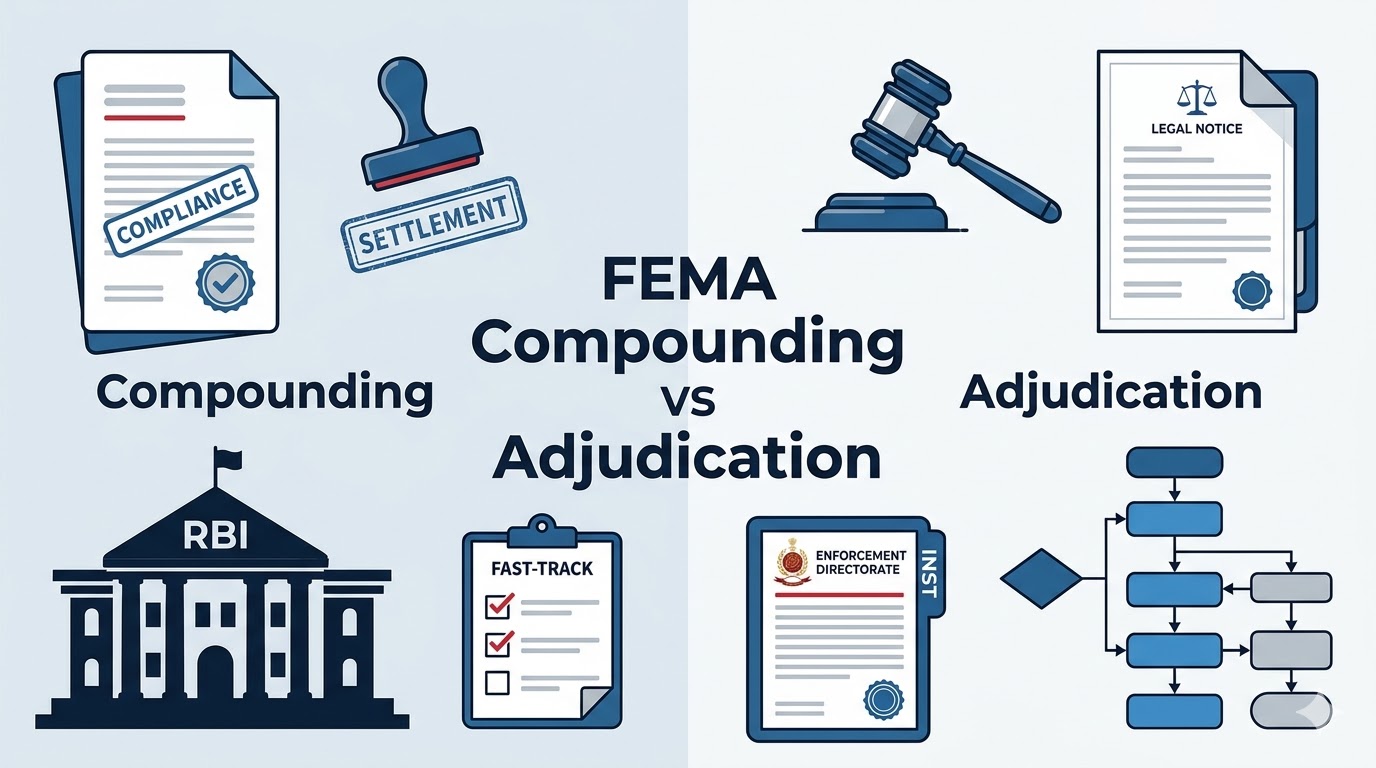
FEMA compounding is a voluntary, time‑bound way to regularise a FEMA contravention by paying a monetary amount, while adjudication is a formal legal process led by Enforcement Directorate (ED) to determine guilt and impose penalties. Both exist under the Foreign Exchange Management Act, 1999 (FEMA), but they work very differently and have very different consequences.
The Foreign Exchange Management Act, 1999 (FEMA) governs how foreign exchange flows into and out of India, with the objective of facilitating external trade and payments and maintaining an orderly foreign exchange market. Any person dealing in foreign currency, foreign investments, overseas assets, or cross‑border remittances whether an individual, startup, large company, or foreign investor has to comply with FEMA and the Reserve Bank of India (RBI) regulations issued under it.
When there is a violation (called a “contravention”) of FEMA or related rules/notifications, the law provides two key pathways: compounding of contraventions under FEMA 1999 and adjudication. Compounding under FEMA focuses on quick, voluntary settlement by paying a compounding amount, whereas adjudication is a quasi‑judicial process that can lead to higher penalties and possible further enforcement.
This article explains FEMA compounding vs adjudication, how each works, and when compounding may be a better route especially for technical and procedural defaults.
A FEMA violation (contravention) occurs when a person breaches any provision of FEMA, or any rule, regulation, notification, direction, or circular issued under it.
Some frequently seen contraventions include:
Compounding under FEMA is a voluntary mechanism where a person who has committed a contravention admits the lapse, pleads guilty, and applies to have it regularised by paying a “compounding amount” instead of going through full adjudication. This is governed mainly by Section 15 of FEMA, the Foreign Exchange (Compounding Proceedings) Rules, 2024, and RBI’s Directions – Compounding of Contraventions under FEMA, 1999.
The key objectives of FEMA compounding rules are:
Historically, RBI has been the main compounding authority, and it continues to compound most technical and procedural contraventions, such as delayed filings and reporting issues.
Under the updated compounding framework and rules:
While details depend on the specific regulation and the latest RBI Master Direction, the broad steps are:
If the applicant does not pay the compounding amount in time, the matter can be referred to ED for further investigation and action.
Adjudication under FEMA is a formal quasi‑judicial process where an Adjudicating Authority examines alleged contraventions, hears both sides, and passes an order imposing penalties under Section 13 of FEMA if a violation is established. It is essentially the enforcement arm of FEMA, usually triggered after an investigation by ED.
The general stages are well‑documented in practice notes and case law:
FEMA provides a multi‑tier appeal structure:
If no appeal is filed within the prescribed time (generally 45 days from receipt of order), the adjudication order becomes final and enforceable.
| Aspect | FEMA Compounding | FEMA Adjudication |
|---|---|---|
| Nature | Voluntary settlement mechanism where the contravener admits the offence and seeks regularisation. | Formal legal enforcement process to determine whether a contravention occurred and to impose penalty. |
| Authority | Reserve Bank of India for most technical/procedural contraventions; ED for certain specified cases. | Adjudicating Authority under FEMA, based on investigation and complaint by ED. |
| Time | Intended to be time‑bound (commonly within 180 days of application). | Can be prolonged due to inquiry, hearings, and appeals. |
| Purpose | To resolve and regularise violations quickly, avoiding detailed proceedings. | To establish guilt, quantify contravention, and enforce penalties. |
| Proceedings | Administrative/settlement‑oriented no further action after successful compounding. | Quasi‑judicial; may lead to further enforcement or even prosecution in serious cases. |
An important practical point from recent judicial view and revised rules: once adjudication is completed and a final penalty order is passed, compounding is generally not available for that same contravention. This reinforces that compounding must be considered before or during adjudication, not as a fallback after losing the case.
In many real‑world cases (especially Reddit/Quora‑style queries about missed FC‑GPR filings or inadvertent FDI mistakes), compounding is usually preferable where:
Always consult a FEMA expert—such as a specialist consultant, FEMA lawyer, or experienced company secretary—before deciding whether to apply for compounding or contest an adjudication notice, because strategy can depend heavily on facts, amount involved, and current enforcement trends.
Imagine an Indian company receives foreign investment in 2022 but fails to file Form FC‑GPR within the prescribed time. The delay is noticed only in 2025 during due diligence for a new funding round.
In online forums, advisors often recommend early compounding in such scenarios to avoid escalation into full adjudication, provided there is no element of money‑laundering or national‑security concern, which are generally non‑compoundable.
To minimise the need for either compounding or adjudication:
Yes. In compounding of offences under FEMA, you voluntarily admit that a contravention has occurred, plead guilty, and seek settlement by paying a compounding amount. This is why it must be a conscious strategic decision, ideally after expert advice.
Generally no. Recent judicial views and RBI directions clarify that once a contravention has been finally adjudicated, a compounding application for the same matter is not maintainable. Compounding is meant to avoid full adjudication, not to undo an adverse adjudication order.
RBI and ED endeavour to dispose of compounding applications within 180 days from the date of receipt of a complete application. Actual timelines can vary depending on workload, complexity, and whether additional information or hearings are needed.
Broadly, the following are typically non‑compoundable:
Exact categories can evolve, so always check the latest FEMA compounding rules and RBI directions.
FEMA is primarily a civil law, and most contraventions lead to monetary penalties, not imprisonment. However, in serious cases (especially where PMLA or other criminal laws are triggered), ED can recommend prosecution under other statutes, so early regularisation and professional handling is strongly advised.
On forums like Reddit and Quora, professionals commonly recommend that if the contravention is still relevant (for example, delayed FC‑GPR or unreported ODI) and not already adjudicated, it is usually better to regularise the transaction and apply for compounding rather than wait for ED action. This is especially true if you anticipate fundraising, sale, or regulatory scrutiny.
If you or your client are facing a potential FEMA contravention, engaging a FEMA expert early can help you evaluate whether compounding under FEMA is available and strategically preferable to full adjudication, quantify potential exposure, and navigate RBI/ED expectations efficiently.