





Written by FEMA Expert: Your All A to Z FEMA and Global Business Related Solution
Non-Resident Indians face a critical decision when managing finances in India: NRE or NRO account? These accounts, governed by FEMA regulations, determine your tax liability, repatriation freedom, and compliance burden. This comprehensive 1200+ word guide clarifies the differences, rules, and real-world scenarios NRIs encounter daily.
FEMA (Foreign Exchange Management Act, 1999) regulates all cross-border transactions for NRIs. RBI implements these rules through banks acting as Authorized Dealers. NRE accounts handle foreign-earned income with tax-free interest and unlimited repatriation. NRO accounts manage Indian-sourced income like rent and dividends but face USD 1 million annual repatriation caps and 30.9% TDS on interest.
Compliance matters because violations trigger account freezes, penalties up to ₹2 lakhs, and repatriation blocks. Understanding these rules prevents costly mistakes.
NRE (Non-Resident External) accounts accept only foreign-source funds:
Key FEMA advantages:
Who qualifies: NRIs, OCIs, PIOs. Joint holders must be non-residents only.
NRO (Non-Resident Ordinary) accounts handle Indian-sourced income:
Key FEMA restrictions:
NRO offers flexibility for local transactions (full UPI access) but higher tax burden.
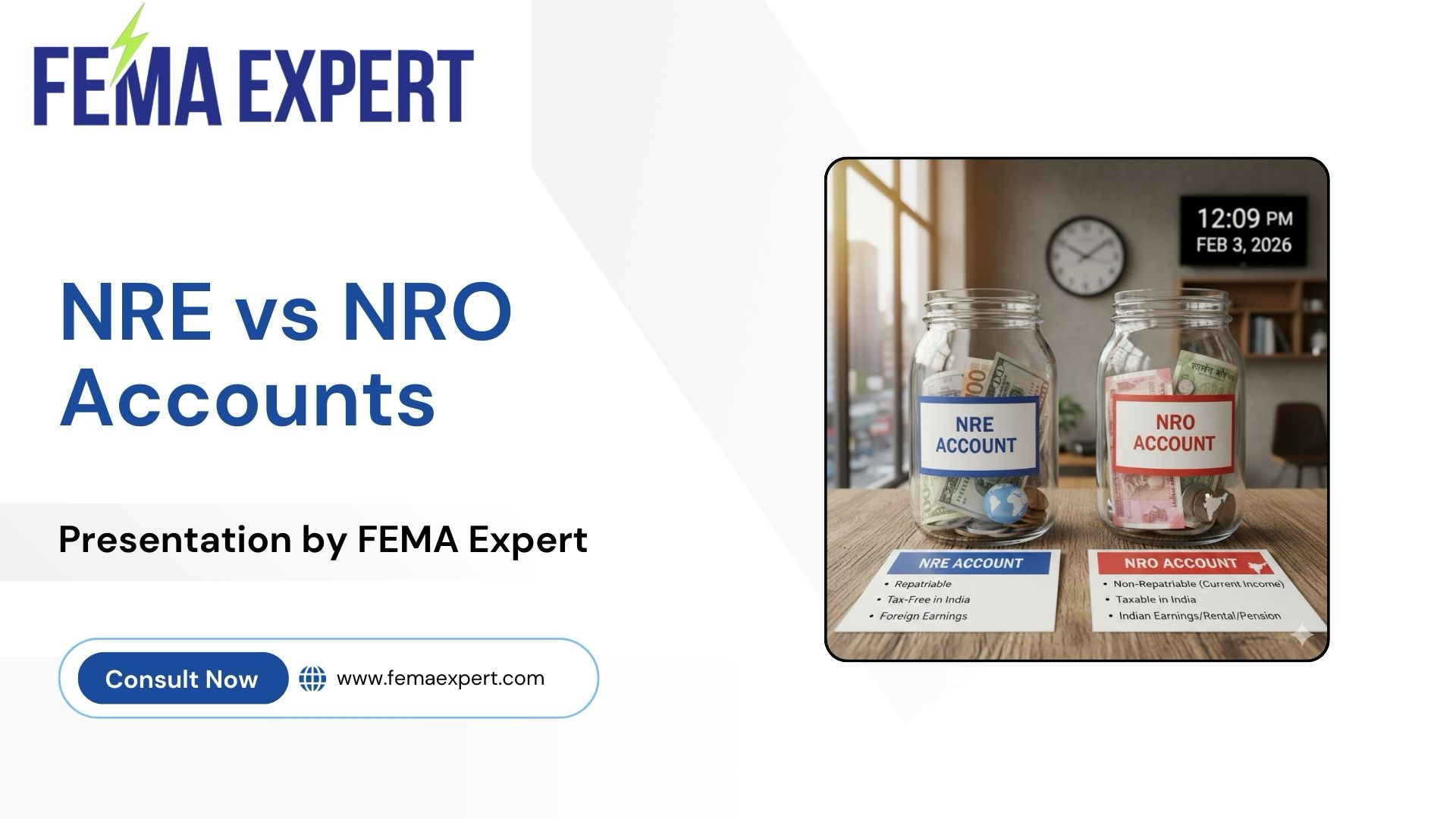
| Feature | NRE Account | NRO Account |
|---|---|---|
| Fund Source | Foreign income only | Indian + foreign income |
| Interest Tax | Tax-free | 30.9% TDS |
| Repatriation | Unlimited | USD 1M/year cap |
| Joint Holder | Non-resident only | Resident relatives OK |
| Currency Risk | Yes (INR only) | No (INR transactions) |
| UPI Access | Limited | Full access |
| Transfer To | Can → NRO | Cannot → NRE |
Permissible credits:
Transfers between accounts:
Documentation requirements:
RBI annual limits:
NRE repatriation (simple):
NRO repatriation (complex):
Current income exception: Rental income, dividends, and interest from NRO are fully repatriable after tax (don’t count toward USD 1M cap).
Interest income:
DTAA benefits: NRIs from USA/UK/Canada can reduce TDS to 10-15% by submitting DTAA forms to banks.
Example: ₹10 lakh FD at 7% yields ₹70,000 interest
Use NRE when:
Use NRO when:
Best practice: Maintain both accounts. NRE for savings, NRO for income/liabilities.
Reddit (r/nri): “Do I need both accounts?”
Most NRIs need both. NRE for foreign salary (tax-free), NRO for UPI payments from India. Banks like HDFC require NRO for local transactions.
Quora: “Can I transfer NRO to NRE?”
No. FEMA prohibits this to prevent converting taxable Indian income into tax-free NRE funds. Repatriate NRO → foreign account → redeposit as NRE (cumbersome).
Reddit: “NRO repatriation limit real?”
USD 1M cap applies only to principal (property sales, inheritance). Current income (rent, interest) repatriable without cap after TDS and Form 15CA/15CB.
Forum: “Returning to India – what happens?”
NRE converts to RFC (maintains repatriability). NRO becomes resident savings. Notify bank within 30 days of residency change.
Quick Checklist:
FEMA compliance protects your wealth. Recent 2025 RBI updates cap penalties at ₹2 lakhs for reporting errors but maintain strict repatriation rules. Consult FEMA experts for complex scenarios like inheritance, property sales, or returning residents.
This guide by FEMA and Global Business compliance experts provides A-to-Z solutions for NRIs. Verify latest RBI Master Directions before major transactions.